

- Day trips
- Tours from Amadores
- Tours from Maspalomas
- Tours from Meloneras
- Tours from Playa del Ingles
- Tours from Puerto de Mogan
- Tours from Puerto Rico
- Tours from San Agustin
Gran Canaria Highlights – Arucas, Teror, Roque Nublo, Valley of the thousand palms, viewpoint of “Degollada de la Yegua, …
Tour through the center of the island while crossing Gran Canaria from north to south and get to know its most emblematic sites. Beautiful landscapes, spectacular ravines, historical and charming towns and monuments that make this excursion the most complete to truly visit Gran Canaria.
The tour starts by leaving the tourist areas of southern Gran Canaria in a northeast direction towards Arucas.
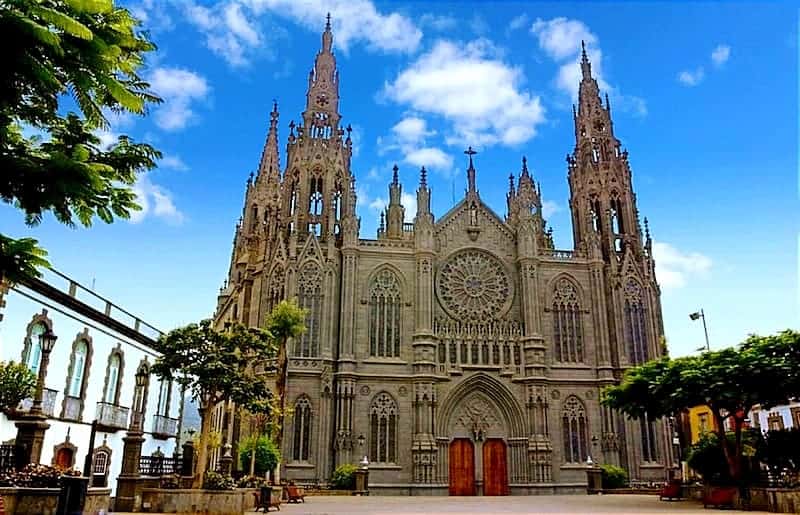
Once in Arucas, you will see the impressive neo-Gothic church of San Juan Bautista, built during the twentieth century, considered by many canarian inhabitants a cathedral.
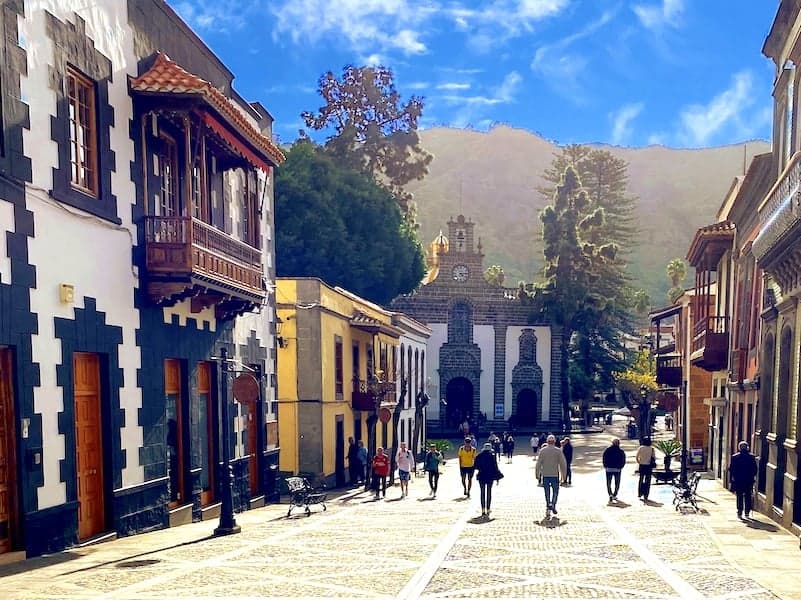
Our next stop will be the village of Teror, one of the most visited towns on the island, cherished by both tourists and residents for its beauty and historical significance. During our visit, we will stroll through its historic centre, where the wooden balconies adorning the house facades stand out, a distinctive feature of Canarian architecture.
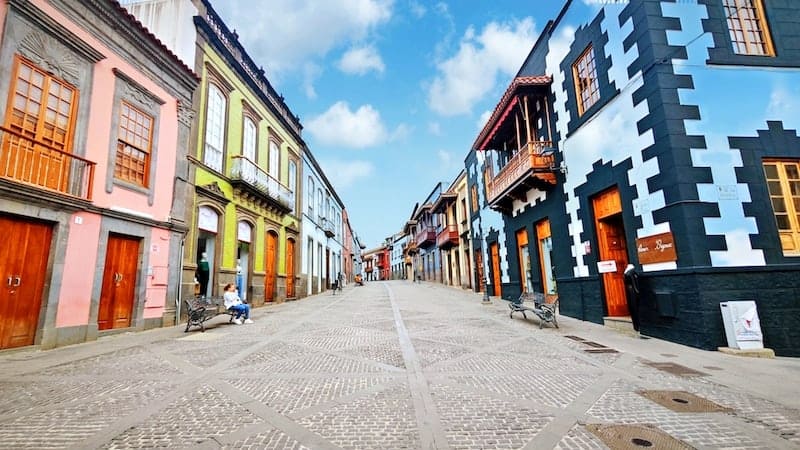
As you walk through the streets of Teror, you will constantly notice these balconies, typically made from Canarian pine.


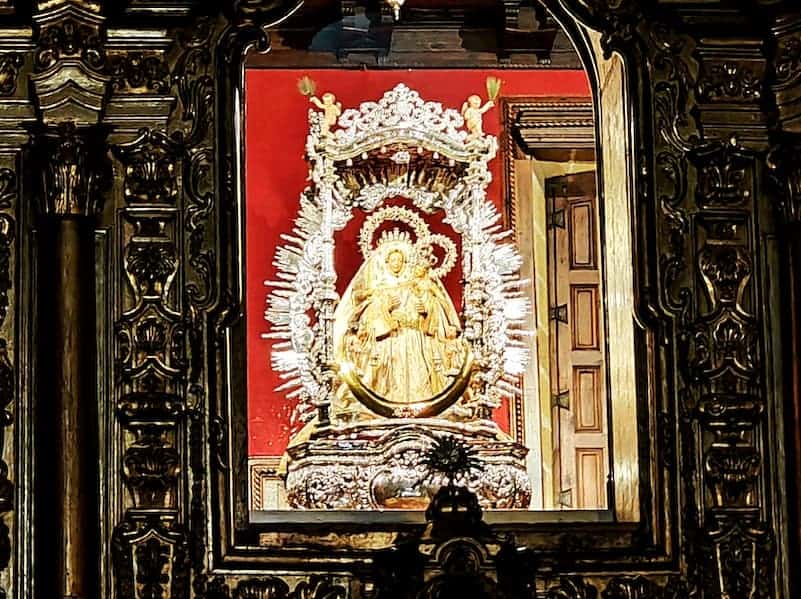
A visit to the Basilica of Teror is almost a must for anyone visiting Teror. Here you will find the Virgin of Our Lady of the Pine (La Virgen de Nuestra Señora del Pino), the patron saint of the island, to whom the people of Gran Canaria are deeply devoted.
![[cml_media_alt id='15649']Basílica del Pino[/cml_media_alt]](https://www.okgrancanaria.com/wp-content/uploads/2018/12/villa-de-teror.jpg)
Observe, throughout the route, the contrasting vegetation. Gran Canaria is known as the “Miniature Continent” because of its diverse climates and vegetation. In the southern part of the island, we will encounter an arid, desert-like landscape. In the inland areas below 1000 metres, palm groves of the Phoenix Canariensis species dominate, while at elevations above 1000 metres, Canarian pine forests (Pinus Canariensis) are more common.

![[cml_media_alt id='9223']pinares[/cml_media_alt]](https://www.okgrancanaria.com/wp-content/uploads/2016/08/pinares.jpg)
On the tour we will make a long stop at a restaurant for lunch. Although lunch is not included in the price, the guide will inform you about the menu option and the cost (around 13 euros), and you can arrange it directly with the guide on the bus.
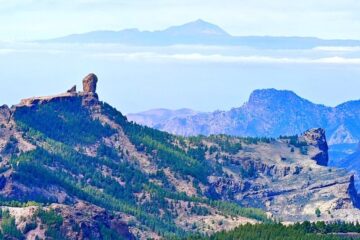
On the way to Cruz de Tejeda, we will stop at the Becerrada viewpoint, at about 1550 metres above sea level. From this spot, you can admire the huge monoliths of El Roque Nublo and Roque Bentayga, two large sacred rocks for the island’s aboriginal people and natural symbols of the island. Additionally, on clear days with good visibility, you can clearly see Mount Teide, the highest peak in Spain at 3718 metres, located on the island of Tenerife.
![[cml_media_alt id='9217']Excursion Cumbres de Gran Canaria[/cml_media_alt]](https://www.okgrancanaria.com/wp-content/uploads/2016/08/20160107_114222-1.jpg)
From Cruz de Tejeda, we will continue descending towards the southern part of the island, heading to Maspalomas. Once again, we will appreciate the constant changes in vegetation, and in the Valley of the Thousand Palms, you will see some of the island’s most beautiful palm groves.

These palm groves are entirely different from the arid ravines further south of the island and closer to the coast. From the Astronomical Viewpoint of Degollada de las Yeguas, you will enjoy spectacular views of some of these deep and long ravines, very similar to the Grand Canyon in the United States.
![[cml_media_alt id='9222']Degollada de la Yegua[/cml_media_alt]](https://www.okgrancanaria.com/wp-content/uploads/2016/08/IMG_20160531_120314-1.jpg)
Our final stop will be an Aloe Vera farm (Aloe Barbadensis Miller) to learn about the medicinal properties of this plant and the characteristics of its cultivation in Gran Canaria.
![[cml_media_alt id='9342']Cultivo de aloe vera en Gran Canaria[/cml_media_alt]](https://www.okgrancanaria.com/wp-content/uploads/2017/02/DSC_0571.jpg)
We hope that, by the end of this great excursion and upon returning to your accommodation, you will feel like you have had a wonderful day discovering some of the most impressive places in this miniature continent called Gran Canaria.
Recommendations
- Comfortable clothes.
- Coats and jackets according to the season.
- Comfortable, closed shoes.
*On Mondays there will not be a specific stop to eat in a restaurant. The guide will recommend you places to eat during the tour.
Frequently Asked Questions
-
From which areas is hotel pick-up available?
Pick-up points are available in all tourist areas in the south of Gran Canaria, including San Agustín, Playa del Inglés, Maspalomas, Sonneland, Meloneras, Arguineguín, Puerto Rico, Amadores, Playa del Cura, Taurito and Puerto de Mogán.
-
What time will I be picked up and where is the meeting point?
When making the booking and indicating your hotel, the booking system will automatically show the pick-up location and time.
If you have any doubts about the exact meeting point, we recommend contacting us before the excursion.
-
From what age can the excursion be done?
Babies and children can participate as long as they are accompanied by adults. Babies up to 24 months travel free and do not occupy a seat.
-
Can people in wheelchairs take part?
Yes, as long as the wheelchair is foldable. This must be indicated at the time of booking.
-
If I have walking difficulties, can I still join the excursion?
The buses are not equipped with special access or adapted for electric wheelchairs. However, guests with reduced mobility or foldable wheelchairs may participate if accompanied by someone who can assist them when getting on and off the bus.
-
Are entrance tickets to museums and attractions included?
They are usually not included unless they are an essential part of the excursion. At each stop, you can decide whether to purchase the ticket or choose one of the alternative options offered.
-
What happens if a place of interest is closed on the day of the excursion?
Excursions operate every day of the year except on 25 December and 1 January. If a museum or attraction is closed, the stop will be replaced by additional time at other locations.

Reviews
Share your experience